Monday, September 15, 2014

Chains, Laurie Halse Anderson

Chains is a historical fiction novel.  It is about a slave girl named Isabel and her journey to freedom.  In the beginning she lives in Rhode Island and her owner dies and she gets sold to a couple in New York.  Isabel and Her sister Ruth are the only thing that each other has, Isabel is very protective over Ruth.   The Mistress is very cruel to her and ends up moving her sister Ruth away.  The Revolutionary War is occurring in New York during this time, it is the Loyalists vs. the Rebels.  It is a dangerous time in the city especially for slaves.  By the end of the book she discovers who she really is and crosses the river to freedom with her companion Cruzon.


This is a really good book but I think you have to be careful with what grade you let read it because it is difficult and very graphic.  At the beginning of each chapter there are dates of when these events take place and then there is a historical quote.  As an activity for my students I would assign a chapter to each student or pair of students and have them read the chapter and then do research and find an appropriate historical quote that goes with the chapter.  This would give students a way to connect with the text and history.  I could also teach about calendar with the book.  It talks about Isabel and Ruth being on a boat to New York so I would have students write about a time they have been on a boat and compare it with Isabel and Ruth’s experience.  If they have not been on a boat I would have students imagine that they were on the boat with Isabel and Ruth and write about the experience.  This would also help students connect to the text.  If students connect to the text they are going to be able to understand the historical importance more.   

Wednesday, September 10, 2014

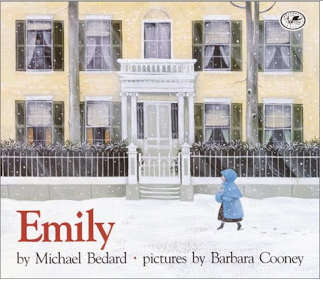
Emily, Micheal Bedard


Emily is a historical fiction picture book about the poet Emily Dickenson.  It is about a mysterious woman who has not come out of her house in twenty years.  The narrator and her family get an anonymous letter asking the mom to come play piano for the women.  The narrator goes to the house too and that is where she meets Emily.  The book has an underlying meaning about going from winter to spring and things’ coming back to life because that is what happens to Emily.
    

While I was reading this book I was wondering if it was a historic fiction book or not.  That is because it is not until the last page that you learn that the text is about Emily Dickenson.  So, the book kept my curiosity up.  To incorporate this into my classroom I would have students pick a historical figure and do some research on them.  Then I would have them write a story where the readers do not truly know who the figure is until the end of the story.  Kind of like a historical figure guess who.  

Working Cotton, Sherley Anne Adams

Working Cotton is a historical fiction picture book.  The narrator is the main character and she is telling about what she does in the cotton field during the day.  It was written in bad English to represent to make it feel like you were there in that time period.  The whole family gets there before light, they build a fire to warm up, they sing while they pick the cotton, eat lunch, work some more, and then leave. 


It is like she had a journal but they wrote a book on the whole days entry.  After reading this book to the class I would have students carry around their writer’s notebook and make notes of what they do throughout the day.  Then the next day I would have students write the details down like a journal entry.  After that they could illustrate a picture to go with the entry.

Girl Wonder: A Baseball Story in Nine Innings, Deborah Hopkinson

Girl Wonder is a historical fiction picture book written in a unique way.  It is kind of like a mini chapter book because the different parts of her life are divided into innings and on the side of the pages that represent a new inning there is a bat and a baseball with the number in it so readers know what inning it is in the book.  In the first inning she threw a corncob at a cat and everyone was impressed.  In the second inning she has her first memory of throwing a ball and gets her name “Girl Wonder.”  In the third inning nothing could stop her from playing ball in the summer she played with the boys and in the winter in a barn where she gets her first fans.  In the fourth inning she is seventeen and everyone is telling her it is time to be a lady.  In the fifth through eighth inning she plays for a semipro team.  Finally, in the ninth inning the book comes full circle.

When I read this I immediately thought of the recent Little League World Series.  Mone Davis is a young girl who is a pitcher on an all-boys team that went far in the Little League World Series.  Mone is literally a present day “Girl Wonder”.  I would read this book with my class and have them do research on Mone Davis.  Then as a class we would create a venn diagram to compare and contrast Mone to the main character in the book.  Then students would write a blog entry about the similarities and differences.     

Abe Lincoln Crosses a Creek: A Tall, Thin Tale (Introducing His Forgotten Frontier Friend), Deborah Hopkinson and Joan Hendrix

Abe Lincoln Crosses a Creek is a historical fiction picture book, but it is also a book like I have never read before.  As you are reading it is the author telling the story, like they are talking to you and reading the story.  As she reads she decides to change it up and change the outcome of the story, like first they walk across the log then she changes it and decides that they are going to crawl across the log.  In the first two pages she sets the stage of the story like characters, setting, and time.  During the book Abe and his friend Austin cross a dangerous river where Abe almost dies but Austin saves us. On the last page of the book it gives the moral of the story which is: What we do matters, even if we do not make the history books.

After doing a read aloud of this book I would have my students choose a historical figure and write their own creative adventure story.  A historical figure could be someone like Rosa Parks, George Washington, Babe Ruth or another figure that I approve to make sure they are learning some sort of history.  Then they would have to do a little research to get background information about the person.  Now it is there time to be creative and write an adventure story like the one Abe went on except with their historical figure.  I would also like them to have a moral of their story like the one in Abe Lincoln Crosses a Creek.  After they finish writing they can draw a picture and we can scan them into their blogs.    

Wednesday, September 3, 2014

Never, Ever Shout in a Zoo, Karma Wilson


Never, Ever Shout in a Zoo is kind of a silly picture book full of alliterations and repetition.  The little girl gives readers advice to never shout in a zoo and tells what might happen in you do.  A bear, a moose, and an ape would get out and eventually let all the other animals out and lock the people in the cages.  An example of one of the alliterations is giant, grouchy, and grizzly.  It has repetition because it repeats what animal got out first, second, third, and so on.  It is a fun book for young readers.


As I was reading this story a story of my own popped into my head that I would share with my students to go along with this book.  My extended family has a farm that we all used to go to about once a month.  They raise cows on the farm.  When I was about six years old my dad, my friend, and I decided to walk down to the bottom of the pasture where there is a creek.  The cows were on the other side of the creek and one of them moved and I screamed and they all got spooked and stampeded us back to the house.  Once they got done laughing at this story I would have them go to their writer’s notebook and either write about an experience or create a story about shouting around animals and what happens.  This would be a great activity for students.  

Zero the Hero, Joan Holub and Tom Litchtenheld

Zero the Hero is a picture book that integrates math with literacy.  It is about the number zero whose dream is to be a hero; he even wears a mask and a cape.  However, Zero has no confidence because he gets left out because he is not a counting number and he has to stand in the shadows of other numbers.  He is invisible with addition and subtraction and no one wants to be divided by him.  He discovers something with multiplication, when a number is multiplied by Zero it equals zero.  Then every other number ran from him and he realized a superhero would not multiply his friends to nothing so he rolled away.  Nobody knew Zero was gone until they needed him to solve a problem and play a game.  When they are all captured by Roman numeral soldiers Zero saves them with the power of nothing.

There are a lot of lessons you could teach using the book Zero the Hero.  When focusing on literacy I would teach about direction of text and reading from left to right.  This is because this book is a little different because it has quote bubbles throughout the book like a comic.  So I would probably read this to my students and point along as we read and show them how to where to read first because I believe it would be a little confusing for students.   Since this is a book about numbers and it talks about place value.  I would read this book with students when we are learning about place value as a way to integrate literacy with math.  So far, this is one of the best books I have found to use for a math lesson, it really teaches students a lot about place value and how zero really can be a hero.